
What Drones Can Do On an Australian Farm
Updated: Sep 14
Agricultural drones in Australia are well past the novelty stage. Around 10% of Australian agricultural businesses now use spray drones somewhere in their operation, and government modelling expects between 8,300 and 23,900 units working on farms by 2040. These aren't camera drones. They're 25kg to 100kg aircraft that spray, spread, map and find things, and each of those jobs replaces hours of ground work.
Below we dive into what each looks like in practice, what it costs and where the payback comes from.

Spraying: usually the first job
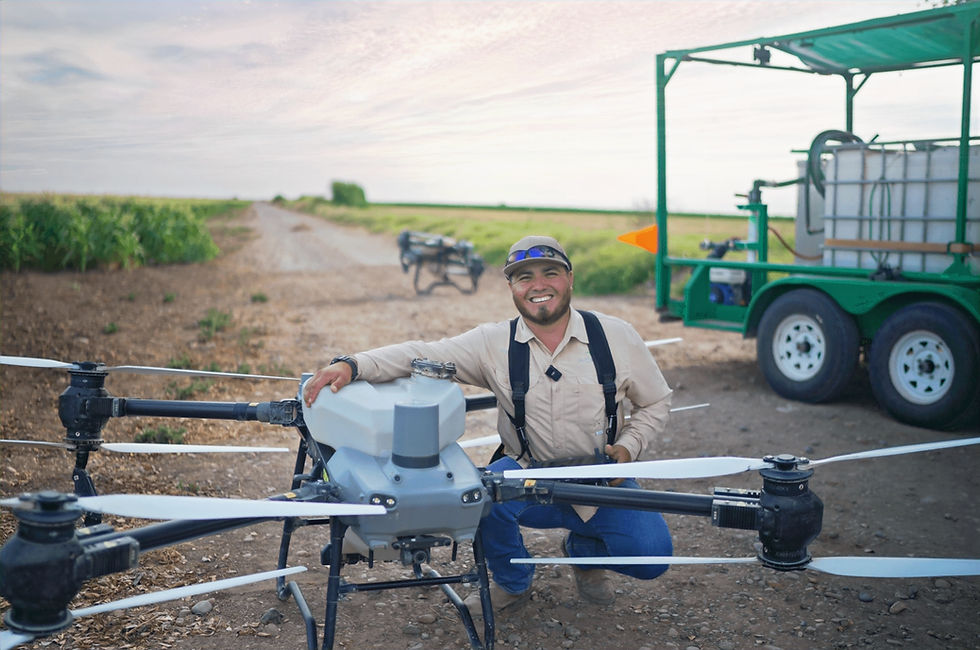
Most buyers start with spraying because the case is easy to make. A drone gets onto waterlogged paddocks when nothing else can, costs far less to run than a plane or helicopter, and covers ground faster than a tractor on a lot of jobs. A spray drone applies herbicide, pesticide or fungicide in 6m to 11m swaths, and the DJI Agras T100 will cover more than 60 hectares an hour in the right conditions. No wheels in the paddock, so no compaction, no crop damage from tramlines and no waiting three days for the ground to dry after rain.
The bigger saving is usually on chemicals, and that comes from spot spraying, where you survey the paddock first and only treat the weed patches, which can cut chemical use by around 70% compared with blanket spraying, depending on how patchy the weeds are. On glyphosate across a decent program, that alone can cover the repayments on the machine.
Capacity has caught up with broadacre expectations as well, and a DJI Agras T50 covers roughly 20 to 30 hectares an hour on liquid application, and the larger T100 carries a 100L tank for bigger programs.

Spreading: seed, fertiliser and bait from the air
Swap the spray tank for a spreading hopper and the same drone handles granular fertiliser, seed and bait. The T100's 150L spreading system takes urea and cover crop seed, and a T50-class machine can spread 10 to 20 hectares an hour depending on the product and rate. On wet paddocks, steep country and pasture renovation jobs where a spreader truck can't safely go, this is often the only practical way to get product on.
Field mapping, crop health imaging and variable rate
Drone field mapping does two things a drive around the property in the ute can't. First, it gives you an accurate, current map of the place including boundaries, dams, drainage lines and crop stages, all stitched together from high-resolution imagery in an afternoon. Second, with a multispectral camera like the DJI Mavic 3 Multispectral, it shows plant stress before you can see it with your own eyes.
That second part is the one worth paying attention to, because a multispectral survey turns into a variable rate prescription map, and your spray or spreader drone then puts more on where the crop is struggling and less where it's already healthy. You stop paying to fertilise ground that doesn't need it, and you pick up pest and disease pressure while it's still a patch instead of a paddock. For a lot of farmers this is where the drone pays for itself, and it can happen in a single spread or spray program if you've been blanket-applying fertiliser across variable country.
Thermal imaging: livestock, pests and finding what's lost
A thermal drone reads heat rather than light, so it works when your eyes don't. Producers use thermal drones like the DJI Matrice 4 Thermal to count stock in timbered country, check calving cows at night without disturbing them, and find feral pigs and wild dogs before they get to the lambs.
The same camera finds lost animals, and our team runs thermal hunting and pet search services in Queensland where it goes the same way every time. A job that would take a day on foot takes about 20 minutes from the air. If it's warm, the camera picks it up.
Surveying and everything else
Off the paddock, surveying drones handle volume measurements on silage pits and stockpiles, inspections of silos, sheds and fence lines, and elevation mapping for earthworks and irrigation design. Jobs that used to mean a surveyor's invoice or a day on the quad now take a flight plan and an hour or so.
What do you need to fly one legally?
Large spray drones need a licensed pilot. For machines over 25kg like the Agras range, that means a remote pilot licence (RePL) rated for the aircraft and the drone has to be registered with CASA. If you're operating a single drone over your own land for spraying, spreading or mapping, CASA's landholder pathway generally means you don't need an operator's certificate (ReOC). Spraying other people's country for payment does need a ReOC, and every state has its own chemical application licensing on top of that. A good training provider will walk you through all of it, and we can point you to one when you buy.
Where to start
The best place to start is with whatever costs you the most right now. If it's chemical, look at a spray drone sized to your hectares. The Agras T50 for a mid-sized farm program, the T70P or T100 if you're covering big country or thinking about contracting, and the T25P if you're a smaller landholder. If it's information, a multispectral or thermal machine for under $10,000 might change more decisions on the farm than anything else you buy this year. Either way, buy from a dealer who has flown these machines commercially. The advice before the sale matters just as much as the warranty after it.
Frequently Asked Questions
How much does an agricultural drone cost in Australia?
The drone itself is only part of the cost, because you'll need batteries and charging gear before it can do any work, and very few farmers buy the airframe on its own. On current pricing, the DJI Agras T50 is $15,000 ex GST, the T70P is $18,500 and the T100 is $24,199, with the smaller T25P at $10,000. Once you add the batteries, charger and generator you need for a full day in the paddock, a working spray setup lands somewhere between $20,000 and $40,000 depending on the machine. Mapping and thermal drones like the Mavic 3 Multispectral and Matrice 4 Thermal are simpler, sitting between $6,700 and $9,800 with far less to add. Call us with your hectares and we'll quote a complete setup rather than just the drone.
Can one drone spray and spread?
It can, because the DJI Agras platforms swap between a spray tank and a spreading hopper, so the same aircraft puts out liquid chemical one week and urea or seed the next. The T100 pairs a 100L spray tank with a 150L spreading system, and there are equivalent systems for the T70P, T50 and T25P.
Do drones work for small farms, or only broadacre?
They work for both, though the economics are different. On a smaller holding, a T25P doing your own spraying replaces contractor callouts and gets to country a boom can't. On broadacre, it comes down to throughput and chemical savings at scale. There's a middle option as well, which is to have us connect you with a contractor from our approved network first, then buy once you know your hours.
How accurate is drone spraying compared to a boom?
Modern spray drones fly GPS-guided swaths of 6m to 11m with terrain-following radar, so height and rate stay consistent over uneven ground. For spot spraying, they're more precise than a boom because they only treat the weed patches picked up in the survey imagery. That's where the chemical savings of around 70% on patchy paddocks come from.
